
The Real Math Behind Renting Tools Instead of Buying Them
In this article
When does renting a tool actually save money? Learn how to calculate break-even points for common home improvement equipment.
Key Takeaways
- Renting beats buying when you use a tool fewer than three or four times total.
- The break-even point depends on purchase price, rental rate, storage cost, and maintenance.
- High-cost specialty tools like concrete saws or floor sanders almost always favor renting.
- Owning makes financial sense for tools you use several times a year, every year.
- Hidden ownership costs, including blade replacements and repairs, shift the math toward renting more often than most homeowners expect.
No long-term storage burden
Specialty tools take up significant garage or shed space. Renting eliminates that footprint entirely, which matters for households with limited storage.
Access to professional-grade equipment
Rental centers stock commercial-quality machines that most homeowners would never buy. A contractor-grade floor sander produces noticeably better results than a consumer model.
No maintenance responsibility
Repairs, blade sharpening, and replacement parts stay with the rental center. For complex equipment like tile saws or pressure washers, maintenance costs are not trivial.
Lower upfront cash outlay per project
Renting keeps project costs predictable and contained. For families managing a tight monthly budget, avoiding a $400 purchase for a one-time task preserves financial flexibility.
Immediate availability of the right tool for the job
Rental inventories include size and capacity options a typical homeowner would not buy. You can rent the exact capacity you need rather than making do with a smaller owned tool.
Costs accumulate quickly with repeated use
A tool rented four or five times can easily exceed its purchase price. Without tracking usage, repeated rentals become the more expensive option over a few years.
Rental availability is not guaranteed
Popular tools like aerators and pressure washers book out weeks in advance during peak seasons. A project timeline dependent on equipment availability can be disrupted.
Return deadlines create time pressure
Day or weekend rental windows can turn a relaxed project into a rushed one. Additional rental days add cost, and rushed work increases the chance of mistakes.
Condition of rented equipment varies
Shared tools are used by many people with varying levels of care. A dull blade or worn part on a rental can slow work and affect quality, though good rental centers inspect tools between uses.
Why the rent-or-buy question matters more than most homeowners realize
A typical home improvement project involves at least one tool you do not already own. The automatic response for many families is to buy it, reasoning that owning is always cheaper in the long run. That assumption is often wrong, and the gap between perception and reality can run into hundreds of dollars per project.
The core issue is that tool ownership carries costs beyond the purchase price. Storage space, accessories, maintenance, and eventual replacement all add up. A tool that costs $180 to buy but gets used once every two years has an effective cost per use that far exceeds a $45 rental. Common home repair myths often include the idea that buying is always the thrifty choice, but the numbers do not consistently support it.
Before starting any project, taking stock of your actual tool needs against realistic use frequency is worth the time. A pre-work checklist that covers tool needs alongside permits and materials helps you make this call before you have already committed to a purchase.
How to calculate your personal break-even point
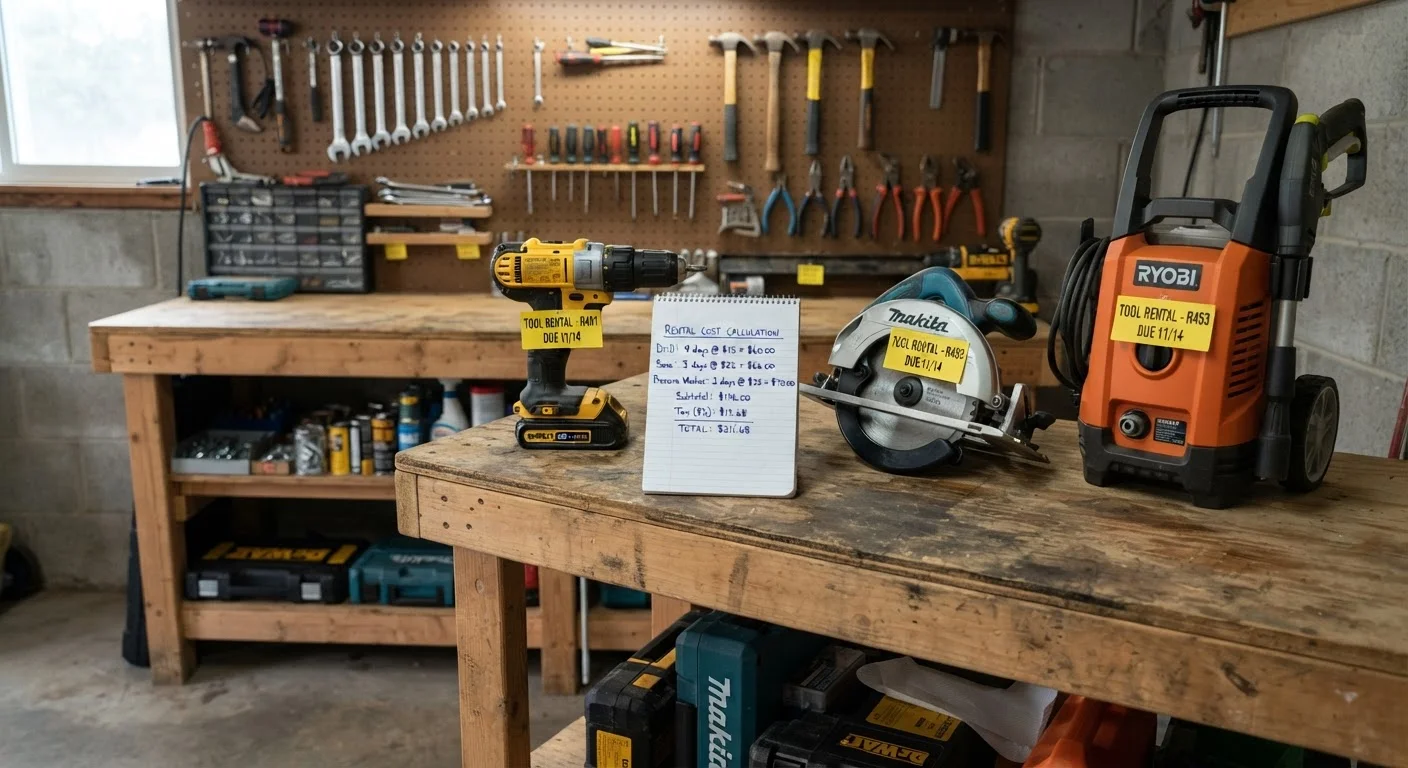
The break-even calculation has four inputs: the tool's purchase price, the rental rate per day or weekend, ongoing ownership costs (blades, bits, oil, repairs), and the number of times you expect to use it per year.
A simple formula: divide the purchase price by the rental rate per use. That gives you the number of uses at which buying becomes cheaper than renting, assuming zero maintenance costs. Add estimated annual maintenance divided by the number of uses per year to get a more realistic figure.
Example: a 10-inch miter saw costs roughly $250 to buy and $45 to rent for a weekend. Divide $250 by $45, and you get about 5.5 uses before buying breaks even. If you expect to use it twice a year on average, buying pays off in under three years. If you plan one project and have no others in mind, renting saves $205 immediately.
5-6x
Typical break-even uses for mid-range power tools
General cost modeling based on average US retail prices and typical rental center day rates for common power tools.
$60-$150
Daily rental rate for specialty tools
Rates for equipment like drum sanders, concrete grinders, and tile saws at national equipment rental centers in the US.
10-15%
Annual ownership cost as share of purchase price
Industry estimates for tool maintenance, consumables, and storage typically range from 10 to 15 percent of original purchase price per year.
Maintenance and storage shift the calculation further. A pressure washer that costs $300 to buy also needs pump oil, a storage spot, and occasional seal replacements. Those costs can add $30 to $60 per year. Adjust the numerator accordingly: $300 plus $90 in three-year maintenance divided by $60 per rental equals 6.5 uses to break even, not 5.
Tools that almost always favor renting
Specialty tools used once or twice over a home's lifetime rarely justify purchase. Concrete grinders, floor drum sanders, tile saws, and log splitters fall into this category for most households. Rental rates for these run $60 to $150 per day, but purchase prices start at $400 and climb quickly. A homeowner refinishing hardwood floors once every eight to ten years will spend far less renting a drum sander each time than owning one that sits in a corner depreciating.
Large outdoor equipment follows a similar pattern. Aerators, sod cutters, and stump grinders are seasonal at best. Renting when the task arises is almost always the financially rational move for a single-family home. Planning seasonal maintenance tasks in advance lets you schedule rentals with enough lead time to avoid rush fees.
No long-term storage burden
Specialty tools take up significant garage or shed space. Renting eliminates that footprint entirely, which matters for households with limited storage.
Access to professional-grade equipment
Rental centers stock commercial-quality machines that most homeowners would never buy. A contractor-grade floor sander produces noticeably better results than a consumer model.
No maintenance responsibility
Repairs, blade sharpening, and replacement parts stay with the rental center. For complex equipment like tile saws or pressure washers, maintenance costs are not trivial.
Lower upfront cash outlay per project
Renting keeps project costs predictable and contained. For families managing a tight monthly budget, avoiding a $400 purchase for a one-time task preserves financial flexibility.
Immediate availability of the right tool for the job
Rental inventories include size and capacity options a typical homeowner would not buy. You can rent the exact capacity you need rather than making do with a smaller owned tool.
Tools that often make sense to buy
A cordless drill, a circular saw, and a basic orbital sander are used across dozens of different project types. A family that does any regular home maintenance will reach for a drill multiple times per year for years on end. At that frequency, a $120 purchase pays off within the first year compared to repeated rentals at $25 to $35 per use.
General-purpose hand tools, levels, clamps, and utility knives have virtually no rental market and low purchase prices. Buying these outright makes obvious sense. The ownership calculus is less clear for mid-tier power tools like a 12-inch sliding miter saw or a belt sander, which is exactly where running the break-even numbers matters most. For context, understanding where household money goes can help frame tool spending within the broader picture of home-related costs.
Costs accumulate quickly with repeated use
A tool rented four or five times can easily exceed its purchase price. Without tracking usage, repeated rentals become the more expensive option over a few years.
Rental availability is not guaranteed
Popular tools like aerators and pressure washers book out weeks in advance during peak seasons. A project timeline dependent on equipment availability can be disrupted.
Return deadlines create time pressure
Day or weekend rental windows can turn a relaxed project into a rushed one. Additional rental days add cost, and rushed work increases the chance of mistakes.
Condition of rented equipment varies
Shared tools are used by many people with varying levels of care. A dull blade or worn part on a rental can slow work and affect quality, though good rental centers inspect tools between uses.
Practical factors beyond the math
Numbers alone do not settle every case. Availability matters: rural households may find rental centers inconvenient enough that ownership pays for itself in saved trip time. Project timing matters too. A rental that needs to be back by 5 p.m. can create pressure that leads to rushed work or additional rental days.
Condition is another factor. Rental tools are shared and sometimes poorly maintained. For precision work like tile cutting or finish carpentry, a well-maintained personal tool may produce cleaner results. That said, reputable rental centers service equipment regularly, so condition is not a reliable argument against renting in most cases.
Finally, consider the household budget as a system. Money spent on a tool that will sit idle is money not available for other maintenance priorities. Spreading maintenance costs across the year is easier when you are not carrying the weight of seldom-used equipment purchases. This connects directly to how households identify which spending categories to trim: tools are a line item, and they deserve the same scrutiny as any other.
When to ask about rental damage waivers
Most rental centers offer an optional damage waiver, typically 10 to 15 percent of the rental fee, that limits your liability if a tool is accidentally damaged during use. For expensive equipment like concrete saws or large compressors, a waiver is worth factoring into your total rental cost estimate. Check the terms carefully, since waivers usually exclude damage from misuse or failure to follow operating instructions.

Author
Home on a Budget Editorial Team
Home on a Budget Editorial Team is the collective byline for our editorial team and contributor network. Articles published under this byline or an editorial pen name are researched, written, and reviewed according to our editorial standards for clarity, consistency, and independence before publication.
View all articles