
Envelope Budgeting in the Digital Age: Cash Envelopes vs. Spending Categories
In this article
Compare physical cash envelopes with digital category budgeting to see which approach fits how your family actually spends money.
Key Takeaways
- Cash envelopes create a hard spending limit because you literally cannot spend money you don't have in the envelope.
- Digital category budgeting tracks card and bank transactions automatically, making it easier for families who rarely use cash.
- Both methods follow the same core logic: assign every dollar a job before the month begins.
- Switching costs matter, so the system a family will actually stick with beats the theoretically superior one.
- Hybrid approaches, such as cash envelopes for groceries and digital categories for bills, work well for many households.
How each system works
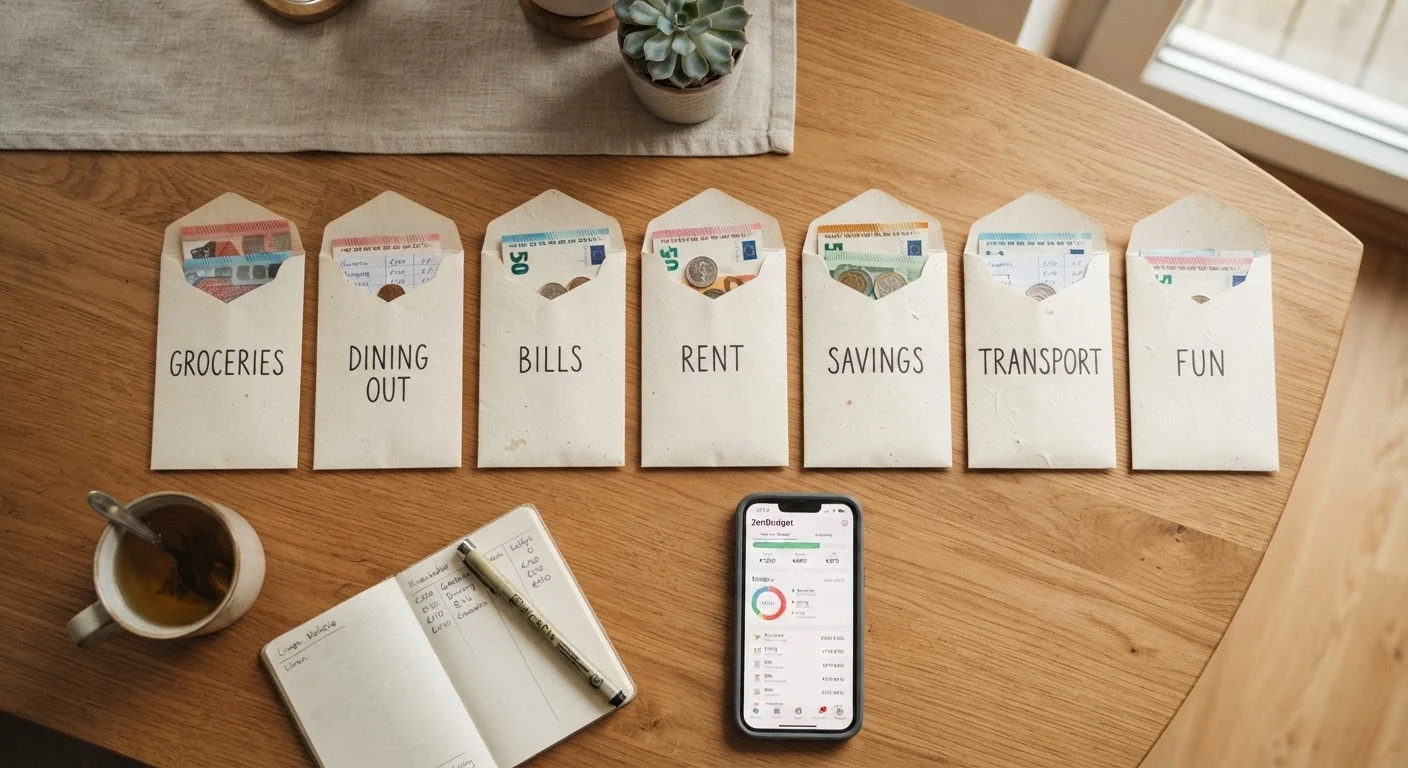
The cash envelope method is straightforward. At the start of a pay period, you withdraw cash and divide it into labeled envelopes, one per spending category. Groceries might get $400, dining out $150, kids' activities $100. When an envelope is empty, spending in that category stops until next payday. There is no app, no password, and no bank sync required.
Digital spending categories follow the same logic but live inside a spreadsheet or budgeting app. You assign dollar amounts to named categories at the start of the month. Every time you spend, you log the transaction, either manually or through an automatic bank feed, and the app subtracts it from the right category. When a category hits zero, you either stop spending or move money from another category on purpose.
Both systems are built on zero-based budgeting, meaning income minus all assigned categories equals zero. The difference is the medium: paper and bills versus a screen and bank data. For a broader look at how household budgets work, see this plain-English breakdown of family spending.
Where cash envelopes have the edge
Physical cash creates what behavioral economists call a "pain of paying." Handing over a $20 bill registers more noticeably than tapping a card for the same amount. For families who know they tend to overspend, that friction is a feature.
Cash envelopes also work without internet access, a linked bank account, or a subscription. A family with inconsistent phone access, or one that simply does not trust apps with banking credentials, can use envelopes with zero tech setup. There is no learning curve beyond labeling the envelopes and filling them.
The hard limit is also cleaner. A digital category can technically go negative if you forget to log a purchase. An empty envelope cannot be argued with.
| Criterion | Cash envelopes | Digital categories |
|---|---|---|
| Setup time | Minutes, no tech needed | 30 to 60 min for app/bank link |
| Works with card spending | No, cash only | Yes, automatic or manual |
| Partner visibility | Whoever holds the envelope | Both, via shared app |
| Hard spending limit | Yes, envelope empties | Soft, unless app enforces |
| Security if lost or stolen | Cash is gone, no recourse | Bank fraud protection applies |
| Irregular/annual expenses | Harder to pre-fund | Easy to accumulate monthly |
| Subscription cost | Free | Free to $15/month depending on app |
Where digital categories have the edge
Most American household spending no longer happens in cash. Utilities, subscriptions, online orders, and many grocery runs go on a debit or credit card. Forcing all of that through a cash envelope system means constant ATM trips and the added step of converting card spending into physical bills, which most families abandon within a month.
Digital categories absorb card and bank transactions naturally. Apps that connect to a bank account can pull in transactions automatically, reducing manual entry to a few taps. Partners can check the same category totals from separate phones, which cuts down on the "did you spend the grocery money?" conversations.
Digital systems also handle irregular expenses better. If the car registration comes due in March, you can build a "car" category that accumulates $30 a month all year rather than scrambling for $360 in one pay period. Understanding how variable expenses behave month to month is worth reading about before you set up any budget: fixed vs. variable expenses explained.
Practical trade-offs to weigh
Security is a real concern with cash envelopes. Lost or stolen envelopes are gone. A digital system tied to a bank account has fraud protections; physical cash does not.
Privacy works the other way. Cash leaves no data trail. Families who prefer that their spending not be recorded in any system have a genuine reason to prefer envelopes.
Grocery and dining categories are where cash envelopes tend to perform best because those purchases happen in person and in cash-friendly amounts. For a category-by-category look at where families actually overspend, this guide on household costs is a useful companion. Travel spending is a category where digital wins almost by default, since carrying category cash through airports adds logistical headaches; where travel budgets fall apart covers the specific patterns that trip families up.
Many households land on a hybrid: cash for the two or three categories most prone to overspending, digital tracking for everything else. That combination captures the behavioral brake of physical cash without requiring a trip to the ATM for every utility payment.
This is general financial education, not personalized advice
The information here describes how budgeting methods work in general terms. Every household's income, expenses, and financial situation differs. For guidance specific to your circumstances, consider speaking with a nonprofit credit counselor or a licensed financial professional. The National Foundation for Credit Counseling (NFCC) connects families with accredited counselors, many of whom offer low-cost or free sessions.

Author
Family Finance Editorial Team
Family Finance Editorial Team is the collective byline for our editorial team and contributor network. Articles published under this byline or an editorial pen name are researched, written, and reviewed according to our editorial standards for clarity, consistency, and independence before publication.
View all articles