
No-Equipment Physical Activity Options for Every Age in a Household
In this article
From toddlers to grandparents, there are effective ways to stay active that require no gear, no gym membership, and no special space.
Key Takeaways
- Bodyweight movement is effective for building strength and flexibility at any age, with no equipment needed.
- Children, adults, and older adults each benefit from age-appropriate activity patterns, even short daily sessions.
- Most no-equipment activities can happen indoors, making weather and budget non-issues.
- The U.S. Department of Health recommends at least 150 minutes of moderate activity per week for adults.
- Mixing generations in movement routines builds household habits and keeps motivation consistent.
Why no-equipment activity works for the whole household
A gym membership, a set of dumbbells, or a treadmill can all help someone stay active, but none of them are required. The human body provides all the resistance and load needed for a meaningful workout at every life stage. That means a household of toddlers, school-age kids, working adults, and older grandparents can all find productive movement options using nothing but floor space and gravity.
The relationship between daily movement and long-term health is well-supported: regular physical activity reduces the risk of cardiovascular disease, supports healthy weight, improves mood, and strengthens bones and muscles. Physical activity guidelines from the U.S. Department of Health and Human Services recommend at least 150 minutes of moderate-intensity aerobic activity per week for most adults, and 60 minutes of daily movement for children ages 6 to 17. None of those guidelines require a single piece of equipment.
The list below covers activities suited to each age group commonly found in an American family home, along with notes on how different generations can participate together. For a broader look at how movement fits into a cost-free wellness plan, see building a family wellness routine without spending extra money.
This article is for general informational purposes only and is not medical advice. Consult a qualified healthcare professional before starting any new physical activity program, particularly for children, older adults, or individuals with existing health conditions.
Toddlers: active floor play and movement songs
Children under 5 are not expected to follow structured exercise routines. The American Academy of Pediatrics recommends that toddlers get at least three hours of physical activity spread throughout the day, across a mix of light, moderate, and vigorous movement. Floor play meets this naturally.
Crawling obstacle courses made from couch cushions, dancing to music, rolling a ball back and forth, and action songs like "Head, Shoulders, Knees and Toes" all build coordination, balance, and muscle control. These activities also support brain development linked to spatial awareness and motor learning. Adult supervision is required, and no specific movements should be forced on a child who shows discomfort.
Toddlers need movement spread throughout the day, not a single structured session.
School-age children: bodyweight games and active breaks
Children ages 6 to 17 need 60 minutes of physical activity daily, according to the U.S. Department of Health and Human Services, with muscle- and bone-strengthening activities included at least three days per week. Bodyweight activities fill that need completely.
Jumping jacks, bear crawls, skip-counting squats, push-up challenges, and indoor hopscotch (using tape on the floor) all develop strength and cardiovascular fitness. Short active breaks between homework sessions, 5 to 10 minutes of movement every 45 minutes, also reduce restlessness and support attention. Many of these can become family games that pull in older siblings or parents.
Short active breaks between study sessions support both fitness and focus.
Teenagers: strength circuits and flexibility routines
Teenagers can handle more structured bodyweight training. Push-ups, squats, lunges, planks, glute bridges, and mountain climbers target major muscle groups and build functional strength. A circuit format, moving from one exercise to the next with brief rest periods, keeps heart rate elevated and mimics the effect of gym-based training.
Flexibility work matters too. A 10 to 15 minute yoga or mobility routine in the morning or before bed costs nothing and can reduce injury risk in teens involved in sports. Many free, reputable yoga and fitness videos are available through public library digital services, which often include streaming platforms at no cost to cardholders. Teens should be encouraged to listen to their bodies and rest when fatigued rather than pushing through pain.
Bodyweight circuits and mobility routines give teens a complete training stimulus.
Adults: progressive bodyweight training and walking
For most adults, three categories of movement matter: aerobic activity, muscle strengthening, and flexibility. Bodyweight training covers the second category completely. Squats, push-up variations, reverse lunges, tricep dips on a chair, and core exercises like dead bugs or hollow holds can be progressed over time by slowing the tempo, adding pauses, or increasing repetitions.
Walking is the most accessible aerobic option. A 30-minute brisk walk most days meets the moderate aerobic guideline and requires no gear beyond reasonable footwear. Parents who walk with children or teenagers model the habit while accumulating their own minutes. Adults managing chronic conditions should check with their physician before changing activity levels significantly.
Bodyweight progressions allow adults to build strength without any equipment investment.
Older adults: balance, mobility, and low-impact movement
For adults in their 60s and beyond, the CDC recommends the same 150 minutes of moderate aerobic activity per week as for younger adults, plus muscle-strengthening activities at least two days per week and, importantly, balance exercises to reduce fall risk. All of these can be done without equipment.
Standing on one foot while holding a counter, seated leg raises, wall push-ups, gentle heel-to-toe walking along a straight line, and slow tai chi-style movements all address balance and lower-body strength. Chair-based yoga sequences allow participation for those with limited standing endurance. Older adults with osteoporosis, recent surgery, or cardiovascular conditions should get medical clearance and may benefit from guidance from a physical therapist before starting independently.
Balance exercises done at home, without equipment, directly reduce fall risk in older adults.
Whole-family activities: movement that works across generations
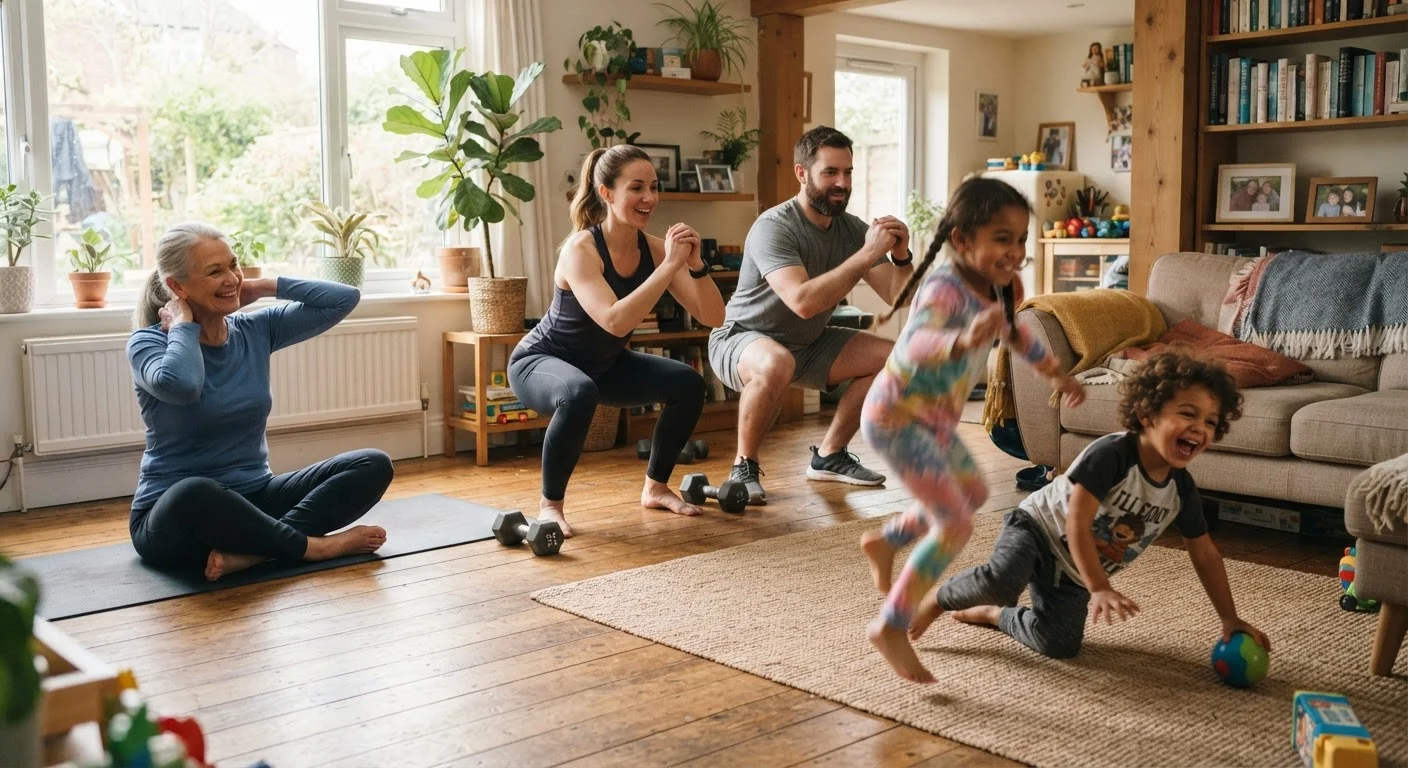
Some activities scale naturally to every age in the same space. Walking is the clearest example: toddlers walk at their own pace, older children can jog ahead and loop back, teenagers can set the route, adults maintain a moderate pace, and older adults can walk at whatever speed is comfortable.
Indoor dance sessions, relay-style activity games in the backyard, simple partner stretching, and stair-climbing challenges (where safe) can all involve multiple age groups at once. These shared sessions build household cohesion alongside physical health. The evidence on incidental movement also supports counting active household time: a family that consistently moves together accumulates meaningful activity even without a defined workout. For ideas on extending active time beyond home, see free and low-cost activities for family outings.
Walking scales to every age at once, making it the most practical whole-family activity.
Making movement a household norm
Consistency matters more than intensity, especially when building habits across a mixed-age household. A short walk after dinner, a five-minute stretch before school, or a weekend dance session in the living room all count. The preventive habits built early in life tend to persist into adulthood, so exposing children to regular movement at home is a practical long-term investment.
When activities are framed as normal parts of the day rather than structured obligations, participation tends to be more consistent across all ages. Older adults who may have mobility limitations can often adapt the same movements done by younger family members: seated versions of exercises, slower-paced walking, or gentle floor stretching all provide genuine benefit. Always consult a doctor before a grandparent or family member with a chronic condition starts a new routine.
Use what you already have
A clear hallway works for walking laps; a living room floor is enough for stretching and bodyweight circuits. Tape marks on the floor create hopscotch or balance beams for younger children. Stairs add natural resistance for adults willing to use them. The goal is movement, and the space most families already occupy is sufficient.

Author
Health & Wellness Editorial Team
Health & Wellness Editorial Team is the collective byline for our editorial team and contributor network. Articles published under this byline or an editorial pen name are researched, written, and reviewed according to our editorial standards for clarity, consistency, and independence before publication.
View all articles