
DIY Maintenance Tasks That Are Safe to Do Yourself (And Which Ones Are Not)
In this article
Learn which routine maintenance jobs most drivers can handle at home and which are best left to a qualified mechanic for safety reasons.
Key Takeaways
- Air filter swaps, wiper blade replacements, and cabin filter changes are genuinely safe for most home mechanics.
- Brake work, suspension repairs, and anything involving fuel lines carry real injury risk and need a qualified mechanic.
- DIY maintenance saves money on labor but only when the job is within the skill level and tools available.
- Skipping a task entirely is always worse than paying a shop to do it correctly.
What makes a task safe to DIY
The line between a reasonable home repair and a dangerous one comes down to three factors: consequences of error, tools required, and how clearly the job is documented in your owner's manual.
A mistake on a cabin air filter means a dusty interior. A mistake on a brake caliper can mean the vehicle cannot stop. That asymmetry is what separates the two categories, not mechanical complexity alone.
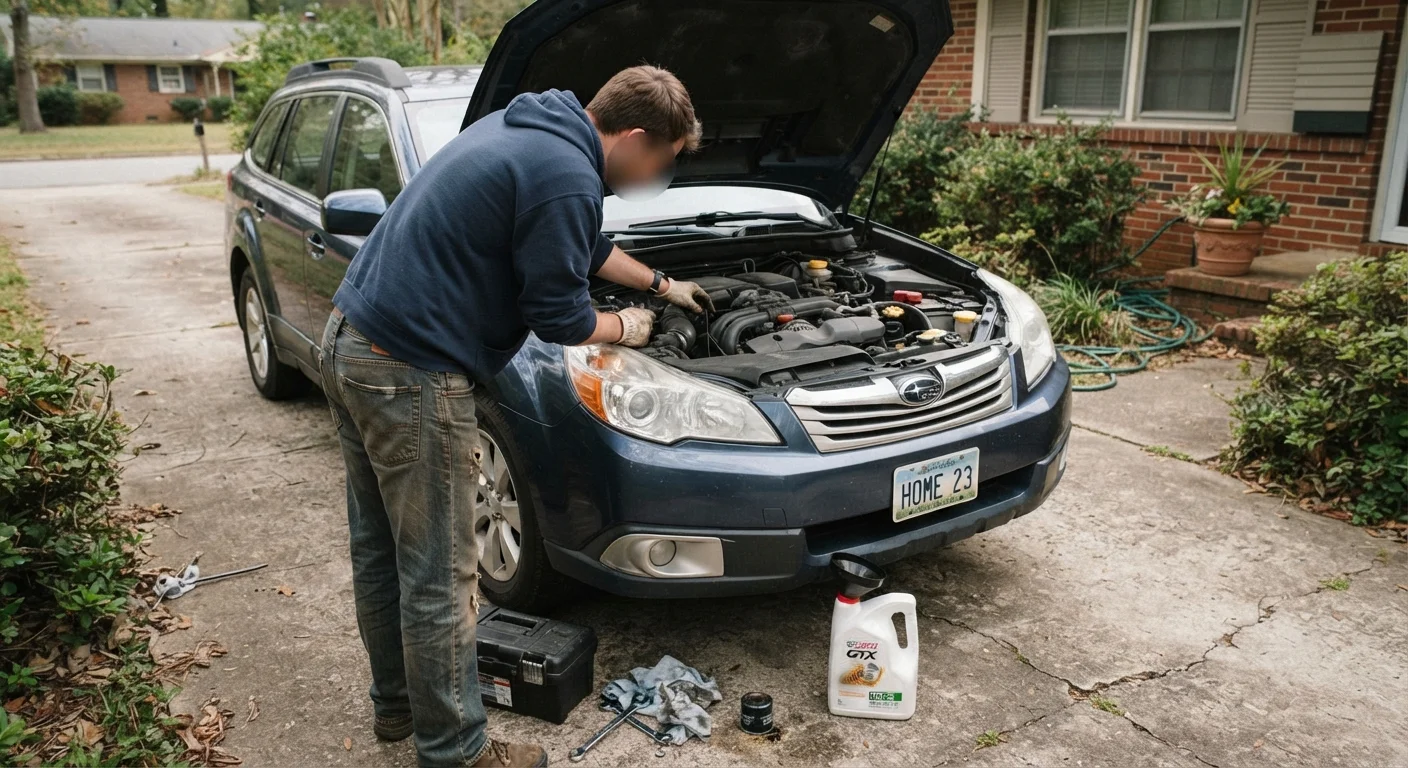
Before starting any maintenance task at home, confirm that your vehicle is on a flat, stable surface, the engine is cool, and the parking brake is set. For anything that requires raising the vehicle, use rated jack stands, never rely on a floor jack alone. Even low-stakes jobs carry real hazards if basic safety steps are skipped.
Tasks most drivers can handle at home
The following jobs share a common trait: the parts are accessible without special tools, the correct procedure is clearly described in most owner's manuals, and a minor error does not create an immediate safety risk.
- Engine air filter: Usually held in a plastic housing secured by clips or a few screws. Most filters slide straight out. Replacing it every 15,000 to 30,000 miles (check your manual) takes under 10 minutes and costs roughly $15 to $30 in parts.
- Cabin air filter: Typically located behind the glove box or under the dashboard. Access varies by vehicle but almost never requires tools. A clogged cabin filter reduces HVAC airflow and can carry contaminants into the passenger compartment.
- Wiper blades: Connectors are standardized enough that most replacement blades include an adapter kit and printed instructions. Replacement takes about five minutes per side.
- Exterior bulbs (most vehicles): Headlight bulb access varies considerably, but tail lights, brake lights, and turn signals are usually reachable through the trunk or a small access panel. Confirm with your manual; some modern headlight assemblies require professional alignment after replacement.
- Topping off fluids: Windshield washer fluid, coolant (to the reservoir only, never open a hot radiator cap), and power steering fluid on older vehicles can all be checked and topped without special tools. Oil top-offs are straightforward too. See our guide on oil change timing for context on why staying current with oil matters.
| Task | DIY-safe? | Typical DIY cost | Skill level | Key risk if done wrong | |
|---|---|---|---|---|---|
| Engine air filter | Yes | $15-$30 | Beginner | Reduced engine performance | |
| Cabin air filter | Yes | $15-$25 | Beginner | Poor HVAC airflow | |
| Wiper blades | Yes | $20-$45 | Beginner | Poor visibility in rain | |
| Brake pads/rotors | No | $60-$150 parts only | Advanced | Brake failure | |
| Fuel system components | No | Parts vary widely | Advanced | Fire or fuel leak | |
| Timing belt service | No | $100-$200 parts only | Expert | Engine destruction |
Tasks that belong at a shop
Several categories of repair look approachable on a video tutorial but carry risks that make home attempts inadvisable for most people.
- Brake pads and rotors: The procedure itself is learnable, but an improperly seated caliper piston, a cross-threaded bleeder valve, or air introduced into the brake lines can result in brake failure. These are not recoverable errors at highway speed.
- Suspension components: Struts, control arms, and tie rods all affect alignment and vehicle stability. Incorrect installation shifts how the vehicle handles in emergency maneuvers. Alignment requires shop equipment regardless, so a mechanic will touch the vehicle anyway after most suspension work.
- Fuel system work: Fuel injectors, fuel pumps, and fuel lines involve flammable liquid under pressure. This work requires depressurizing the fuel system correctly, and any leak creates a fire risk. A licensed mechanic has the training and equipment to manage that safely.
- Timing belt or chain service: Interference engines (where the pistons and valves share the same space in the cylinder) will sustain severe internal damage if the timing is off by even a fraction. This job requires precision torque tools and, in many cases, specialized timing pins or locking tools specific to the engine family.
- Airbag system work: Any repair near airbag sensors, wiring harnesses, or inflator modules requires disabling the supplemental restraint system correctly. Accidental deployment causes serious injury. Leave all airbag-adjacent repairs to a shop.
The real cost calculation
DIY maintenance makes financial sense when labor savings exceed the cost of any tools needed, and when the risk of an error does not carry a large potential expense. An air filter that costs $20 at a parts store versus $60 at a shop (including labor) is a clear win for home service. A brake job where a mistake leads to rotor damage or an accident is a different calculation entirely.
Staying current with basic maintenance also has a compounding benefit: a clean air filter, properly inflated tires, and fresh spark plugs (a moderately difficult DIY job on many older engines) each contribute to fuel economy. Small savings per fill-up add up over a year of driving.
If a task requires a tool that costs more than two professional service visits, that tool may not be worth buying for a single repair. However, tools like torque wrenches and multimeters are useful across many jobs and are reasonable long-term investments for a home garage.
This article provides general educational information about vehicle maintenance. It is not a substitute for advice from a qualified mechanic. Always consult your vehicle's owner's manual and, where safety-critical systems are involved, have the work inspected or performed by a licensed professional.

Author
Automotive Editorial Team
Automotive Editorial Team is the collective byline for our editorial team and contributor network. Articles published under this byline or an editorial pen name are researched, written, and reviewed according to our editorial standards for clarity, consistency, and independence before publication.
View all articles